Monday, January 4, 2016

Return To A Galaxy Far, Far Away: A Star Wars Review

It has finally arrived, the highly anticipated seventh chapter of the Star Wars saga has hit theaters everywhere. For many fans, there is no better place for the holiday season and the year to end than in a galaxy far, far away. The new film, Star Wars: The Force Awakens, returns to audiences to familiar space while still pushing the beloved franchise forward. The Force is strong with director J.J. Abrams, masterfully balancing humor, action and wonder as viewers embark on this adventure. Being an avid Star Wars fanboy for over 21 years, I am proud to announce that the movie lives up to my very high expectations.

The hype for this latest installment has been steadily rising since The Walt Disney Company acquired Lucasfilm (for a staggering $4 billion) in 2012 and vowed to continue making new Star Wars films. I have personally been following every scrap of news, painstakingly analyzing each trailer frame-by-frame and speculating endlessly. Over the past few months, my excitement for The Force Awakens has bordered on obsessive, somewhat mirroring the film’s extremely zealous marketing. For essentially anyone with a pulse, it has been almost impossible to be unaware of this film’s release. It is certainly no surprise that Star Wars has vaporized box office records much like the Death Star did to the planet of Alderaan. 

The newest segment of the epic space tale picks up 30 years after the events of Return of the Jedi (1983), showing what has become of the iconic heroes and introducing some new ones. The movie feels very much at home with the tone of the original trilogy, even paralleling some story elements from A New Hope (1977). The Force Awakens does a fantastic job of creating a sense of nostalgia that flows organically with the story. Each “legacy cast member", as they were referred to during filming, is reintroduced in very fitting ways; Han, Chewie, Leia, Luke, the droids and the Millennium Falcon (a character unto itself) are all integral to the plot of the movie. Seeing these characters again is such a fulfilling feeling for fans both young and old.
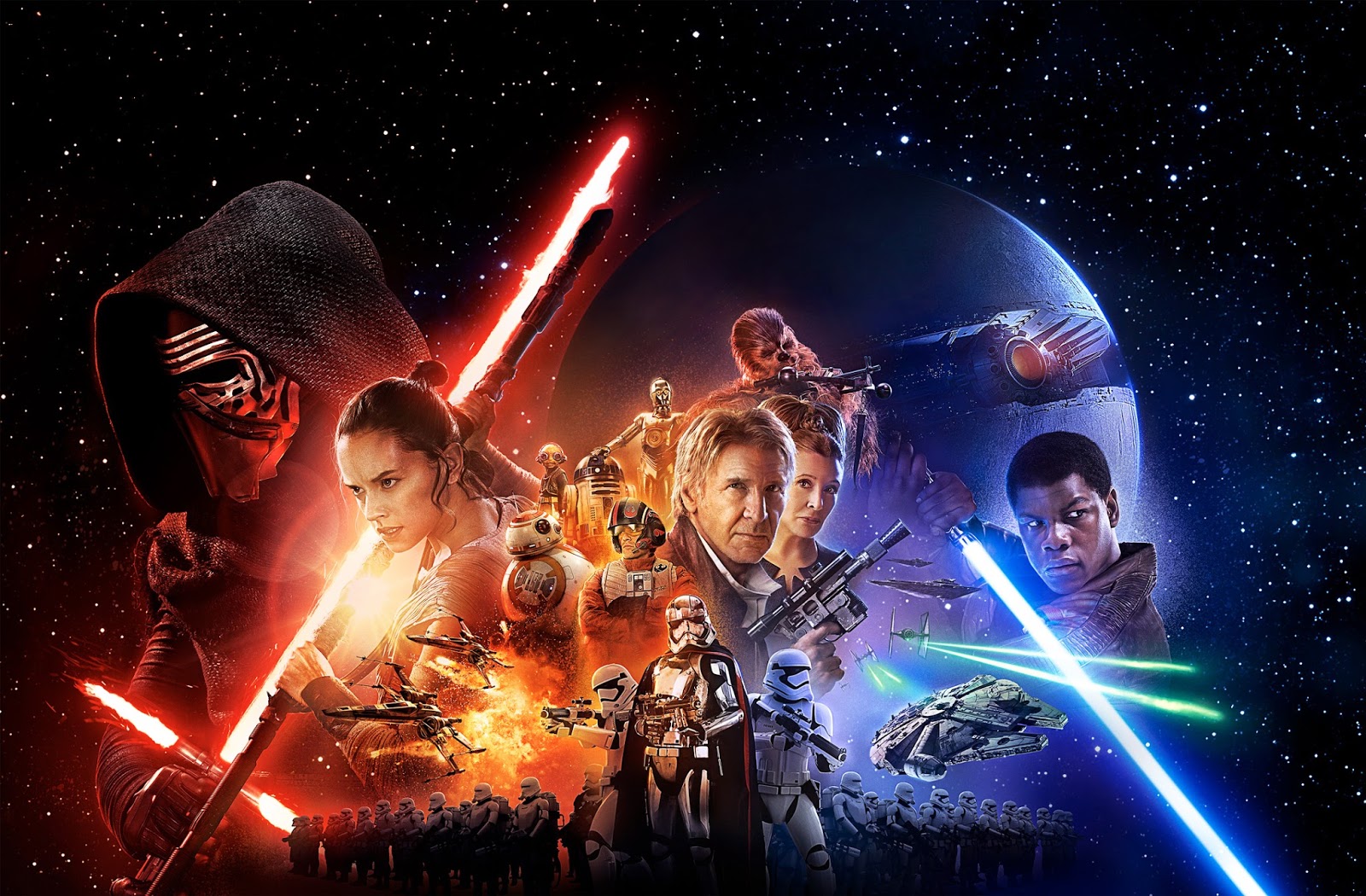
The new characters also tie in excellently with the series, providing some fresh faces and storylines to the Star Wars universe. John Boyega delivers an engaging and at times humorous performance as Finn, a Stormtrooper with a change of heart. Rey, played by Daisy Ridley, is an extremely strong and self-sufficient scavenger turned unexpected hero from the desert world of Jakku. Other notable performances include Oscar Isaac as the fearless resistance pilot Poe Dameron and Lupita Nyong’o as the Yoda-esque computer generated Maz Kanata character. The film’s main antagonist Kylo Ren (Adam Driver) embodies a more immature and entitled villain than Darth Vader, a figure who Kylo idolizes. 

What truly stands out about this movie is the brilliant balance between CG and conventional effects, there are stunning visuals as well as practical sets and retro creatures designs. The film’s music is also worth pointing out, the legendary John Williams once again created a epic and moving score, using familiar themes and beautiful new compositions. Star Wars: The Force Awakens is a remarkable cinematic experience, evident by my three viewings, that induces a childlike sense of wonder. To me, Star Wars is a way of life; it is more than the merchandise, marketing or the hype, it is about the absolute feeling of joy.

Wednesday, December 16, 2015

Keep Calm And Call Captain America

One of my favorite superheroes of all time is Captain America, a man with superhuman strength as well as morals. Marvel Comics boasts a truly massive collection of larger-than-life heroic characters with unbelievable powers, incredible cunning and amazing technology, however, Captain America is easily the most idealistic. When it comes to comic book crusaders, often times the most powerful aspect of who they are is what they fight for, what they believe in. Cap truly embodies the spirit of freedom and justice, fearless as he is loyal.

Captain America No.1.
The origins of the Captain America franchise can be traced back to the Second World War, the first issue of the popular comic series being published in March of 1941. This patriotic super soldier was created by Joe Simon and Jack Kirby of Timely Comics which would eventually become Marvel. Captain America was the company's most popular comic during World War II, especially among American G.I.s overseas. This comic instilled a sense of confidence and hope, a reason to fight for the greater good. 

The popularity of this iconic series wavered after the war, even being canceled a few times before it’s more permanent revival in 1968, during the height of the tensions with the former Soviet Union. Over the years, the Captain America character has evolved becoming more complex and conflicted with the changing  times. In one of the most interesting storylines, making the big screen debut in Captain America: Civil War (click to watch trailer), forces Cap to wrestle with the idea of a superhero registration that pits him against fellow hero Tony Stark A.K.A Ironman. The patriotic hero’s internal struggles often parallel the real life political conflicts within our nation.

To me, Captain America represents not necessarily what the United States is but what it strives to be, what it could be. This righteous hero stands up for all those in the grips of tyranny and never surrenders from a fight. He also believes in the rights of freedom no matter the obstacles, he battles oppression where ever it may exist. These are personally qualities that I find to be very admirable, qualities I hope to emulate within my own life. Captain America may be a fictional character but symbolizes the very real idea of doing the right thing and having a strong sense of morality.

Whether he is battling the forces of Hydra, evil robots, hostile extraterrestrials or even other superheroes, Cap is a man of integrity bound by duty. Long before Steve Rogers was injected with the experimental serum or carried an indestructible shield, he was a strong-willed kid from the Brooklyn. He cared about others before it was expected of him and far beyond his own safety. Even when his best friend Bucky became the ruthless Winter Soldier and tried to kill him, Captain Rogers cared deeply for the well-being of his brainwashed friend.

Superheroes may be one of the most unique creations of human storytelling, drawing from elements such as ancient mythology, science-fiction, fantasy and current events. These epic tales present imaginative characters and extraordinary situations juxtaposed with relatable emotions and themes. Captain America shines as an example of modern folklore, a narrative that we can all relate to in some small way. In moments of doubt and fear, all too common in today’s world, we should stop to ask ourselves: What would Captain America do?

Monday, December 7, 2015

Not A Prop: Ableism In Celebrity Culture

One of the most puzzling aspects of American life in the 21st century is our outright obsession with all things celebrity related, the odd worship of strangers we presume to know. This bizarre cult of personality that our society supports, mostly remains a sort of benign noise constantly in the background for those uninterested but every once in a while it crosses a serious line. The latest major celebrity faux pas, not related to The Donald, is Kylie Jenner's blatantly offensive photo-shoot for Interview magazine that used a wheelchair as metaphoric prop. This act of painfully obvious ignorance, while terrible unto itself represents a larger problem in the relationship between disability and celebrity culture.

This is not ok...
When Kylie Jenner, a celebrity that requires a flowchart to trace the origins of her fame, donned her rather kinky outfit and sat in a blisteringly tacky manual wheelchair, it sent a clear message of how the industry views the disabled community. More shocking still, the supposedly “artistic” justifications behind this blunder was that it represented the limiting nature of fame. Not only does this turn an essential mobility device, that actually grants freedom, as a strange fetishized accessory but it presents disabled people in an extremely problematic light. Disability is not a metaphor to be used at will, disabled individuals are not some novelty to be imitated for shock value.

Unfortunately, Miss Jenner’s stunt that somehow no one thought was wrong before it went to print, is part of a much larger issue. Across the entertainment industry disabled people are largely excluded; disabled actors and models can get very little work, meanwhile, abled actors are cast in disabled roles and abled models are seen as the default option. The fact that Kylie’s photo-shoot even took place shows just how poorly this industry as well as the general population understands what it means to be disabled. I strongly believe there needs to be a major shift in the public narrative surrounding disability.

Blogger Erin Tatum (left) and You-Tuber Annie Segarra (right).
Fellow disabled blogger Karin Hitselberger’s now viral post, Why We Need to Talk About Kylie Jenner, perfectly sums up the importance of this discussion. As Karin puts it, "We need to talk about Kylie Jenner because this is not really about her. It is about how disability can be considered cool when used as a prop, but so often the lives of actually disabled people are seen as a terrible fate.” The disabled community’s overwhelming backlash to this celebrity blunder has sparked an important dialogue that I truly think everyone should pay attention to. The online response, in the form of blogs and recreated photos with women who are actual wheelchair users, is both empowering and enlightening.

The Kylie Jenner photo fiasco is certainly troubling, however, it does present a unique learning opportunity for the public. Anytime there is a situation in which a   particular minority group is offended by something in the popular media, the phrase “Political Correctness” tends to come up at some point but I disagree with that judgement. I believe when a specific group speaks up it is a chance to better understand those with different lived experiences, in this case disabled individuals. As a disabled person myself, I hope that perceptions will continue change and that our society will begin to see the beauty and complexity of true disability.

Tuesday, November 17, 2015

Acts of Hate

Hate and fear are the catalyst for so much of the darkness in this world, so much of the violence, the pain, the death and the suffering. The world has once again been struck by the scourge of organized terrorism, the murder of innocents with the sole purpose of creating fear. The devastating Paris attacks that have left more than 130 people dead as well as the attacks in Beirut, Baghdad Kenya and Nigeria remind us that there are still many out there who wish to do harm to all. As President Obama said in his address, “It's an attack not just on the people of France, but this is an attack on all of humanity…” 

(Tossed about but not sunk)
There is a palpable feeling of grief and despair across much of the world, especially in city of Paris as they begin to recover from the third and most deadly set of attacks this year. The United States shows it’s solidarity with France, our oldest ally, just as France has done for us in the past. My thoughts go out to all those affected by this brutal tragedy, it truly sickens me to think about such senseless acts of violence. The sense of loss, of anger, of fear seem all too familiar to the 9/11 attacks in our country 14 years ago. However, we have endured and so will the French; as the motto of Paris says, "Fluctuat nec mergitur”, tossed about but not sunk. 

Terrorism is by no means a new phenomenon but it represents the evil that humanity is capable of and the danger of indoctrination. The modern face of terrorism is made up groups like ISIS, Al-Qaeda, Al-Shabaab and Boko Haram; militant groups with a warped view of religion carrying out violence for their own perceived gain. These extremists have shown time and time again that they have no regard for human life, indiscriminately killing men, woman and children of all faiths. The vast majority of the nearly 1.6 billion Muslims on the planet firmly denounce these murderers. Terrorists represent Islam as much as the Klu Klux Klan represents Christianity.

The facts about what terrorism is and what it is not, are important to remember in the days and months ahead, particularly in regards to the refugee crisis. Many politicians and pundits in the US have already taken to using the recent attacks as political rhetoric. It saddens me to learn that the governors of around 20 states have gone so far as to say they would refuse to help the 10,000 heavily vetted refugees expected to enter our nation. In this time of international turmoil, some have chosen to turn their backs on those who understand, better than most, the suffering that ISIS has brought to so many lives. Compassion for fellow humans in need is the biggest tool that the average citizen possesses to erase hate.

No matter what you believe or where you are from, we share this world together, beating hearts and thinking brains alike. A passage from the Qur’an, the holy book of Islam, reads, “Humanity is but a single brotherhood: so make peace with your brethren.”  I may not be a religious man by my faith lies deeply withtin humanity and a better tomorrow. Peace will rise above tyranny and violence as long as there someone left to believe in it.

Monday, November 9, 2015

Michael Goes to the Dentist

It’s a Tuesday, I sit in the dentist office waiting room, Hotel California by The Eagles playing ominously in the background. “You can check-out any time you like, but you can never leave!”; the song declares as I anticipate the biannual assault on my gums. Long have I loathed this experience, the agreed-upon low-key torture that is routine dental cleaning. The hygienist arrives in the doorway smiling, we exchange pleasantries but both of us know I would rather be somewhere else, anywhere else. Going to the dentist epitomizes the concept of having to do things in life that we do not want to do.

I maneuver my wheelchair in to place, no hideous tan vinyl recliners for me. The small-talk continues as I look around the exam suite; part starship Enterprise, part interrogation room and all business in muted white and gray colors. An enormous photo of a woman’s teeth hangs from the wall, a menacing disembodied grin presiding over the room like the bespectacled eyes of Dr. T.J. Eckleburg in The Great Gatsby. What is it about going to the dentist that is so unpleasant? Is it the sights, the sounds, the smells or just the invasiveness of it all? There is something so strange about having someone you barely know put their hands and various tools into your open mouth.

The adjustable dental light shines blindingly in my face as if I am about to be questioned about nuclear launch codes. The cleaning begins, it is not particularly painful, more of a persistent annoyance. “Are you ok?” asks the hygienist, sensing my slight discomfort. “Mhmm.” I mumble over the sound of the suction. I wince again as the dental pick pokes my lower gum, my dentist office uses water-pick technology but it is still a medievalIy sharp object. My mind wanders as this irksome process proceeds, time seems to slow.

Logically, I understand the need for going and go with little protest (for the most part), however, it is one of those things I will never get used to doing. Some people actually like going to the dentist. Is it sadism? A compulsion? Clean, all must be clean. Or are those who enjoy this experience simply braver people than the rest of us, souls of stronger fortitude? I like having clean teeth as much as the next person, Americans are notoriously overzealous when it comes to our teeth, but these encounters have always felt a bit traumatic to me.

After the poking, the scraping and high-pressure jets of water, the rest of the appointment flows by like a blur. The hygienist carefully polishing each tooth and the dentist examining those said teeth, all to the soundtrack of somber elevator music. Before I know it, it’s over; everything checks out, the next appointment is made and I find myself back in the waiting-room. As I wait for my mom to return, I cannot help but feel utterly relived. That wasn’t so bad. I think to myself, what I always think to myself. I have survived, triumphed, I have gone casually to the dentist once again. 

Tuesday, November 3, 2015

A Sky Full of Stars

What do you feel when you gaze into a sky full of stars? This question, as simple as it may sound, can reveal so very much about who we are. There is something so primally human about staring at the vast expanse of space, wondering just what our place is in this universe. From the earliest humans to the most cutting-edge scientists, this fascination with the great celestial horizon has pushed our species forward. The more we understand about this breathtaking cosmos we inhabit, the more we feel drawn to knowledge, drawn the mysteries yet to be solved.

"Space is big. Really big. You just won’t believe how vastly hugely mindbogglingly big it is." Douglas Adams remarked in his humorous sci-fi series, The Hitchhikers Guide to the Galaxy. For me, just thinking about the sheer size of the known universe is a rather humbling experience; when I look at the stars I cannot help but feel small but also infinitely part of something much, much bigger. When I was around seven or eight years old my parents bought me a telescope, my father in particular took an interest in showing me the constellations and other heavenly bodies that filled the night sky. From Orion's Belt to the Milky Way, Cassiopia to Polaris the North Star, each speck of light a had story to tell. I felt part of a tradition passed down for thousands of years, from generation to generation.

Looking at the stars is so deeply ingrained in the human narrative, a tool for the imagination as well as the physical world. The stars helped us to create stories and myths, to plant crops and to navigate sea and land, they have truly allowed our society to advance. Before humanity could even comprehend the concept of anything beyond our own planet, space had captured our collective interest. As our understanding of science expanded our views of the universe passed from the realm of mysticism and legend to that of facts and logic, outer space became a tangible place. The prospect of interstellar exploration fascinated our species long before the technology to do so was even conceived. 

Science changed our perspective, imagination took us that next step forward. Jules Verne, for instance, wrote the novel From the Earth to the Moon more than one-hundred years before Neil Armstrong and Buzz Aldrin set foot on the lunar surface. When we had just barely scratched the surface of spaceflight, minds like Gene Roddenberry who created Star Trek and George Lucas creator of Star Wars, imagined a time where intergalactic travel is commonplace. Fantasy and scientific fact have both, in their own way, brought us closer to the stars. The great power of the human mind has helped us begin to boldly go where no one has gone before. 

As we imagine a brighter future, space is almost always part of that vision, part of that dream for a better tomorrow. Every astronaut, astronomer, astrophysicist and science-fiction writer started out as a child looking at the stars dreaming of something bigger. The spirit of exploration is as big a part of who we as the cosmos. Carl Sagan once famously said, “The nitrogen in our DNA, the calcium in our teeth, the iron in our blood, the carbon in our apple pies were made in the interiors of collapsing stars. We are made of starstuff.”  We are not only in the universe, we are the universe, each one of us infinitely connected to everyone and everything around us.

Monday, October 26, 2015

Live Your Truth, Love Yourself, Help Others

This past Sunday, I had the pleasure of speaking for Maureen’s Hope Youth Club, a part of Sue Bertrand's wonderful organization. I was truly honored to talk to this group of great young adults who contribute to the community in such a positive way. Below is an adapted version of my notes from my talk, while it is not necessarily what said word for word (I tend to improvise) it is the essence of what I had to say.

The theme of Sunday's event is inspired by Maya Angelou's enlightening quote, “When we know better, we do better.” Many remember Maya Angelou for her powerful literary and artistic contributions, however, another major aspect of her legacy is activism. 

Heavily involved with the movement for black civil rights both in the US and abroad, Mis. Angelou worked with leaders such as Martin Luther King Jr. and Malcolm X and Nelson Mandela. She also took part in the feminist and LGBT rights movements. In 2011, Maya Angelou was presented with the Presidential Medal of Freedom, the highest civilian honor, for her lifetime of achievement. Maya Angelou may have passed away last year but her words live on, her voice is immortal.

History is truly made by those who challenge the status quo, those who seek change within, and far beyond their own lives. Social justice movements are born from a devoted few speaking up for others and working towards a common goal. Many of my personal philosophies are inspired by the brave men and women throughout history, who have changed the world through their words and actions.

One movement, in particular, that is very important to me is the push for disabled rights that originated the 1960’s. After the Civil Rights Bill of 1964 was passed, a law that set to out to end discrimination based on race, religion or national origin, activists felt that Americans with disabilities deserved this same protection under the law. They presented the idea that access is a human right, that it is equality.

Much like with African-American civil rights, disability activists looked to change laws as well as perceptions. At the time, the majority of disabled individuals like myself were excluded from society because of widespread inaccessibility, stigma and mass institutionalization. So many people were denied a voice because of the way the system was designed. Activists spoke out not simply because it was the right thing to do but because it was the only thing to do.

Things have certainly improved as a direct result of this movement, just the very fact I’m here in front of you right now proves that. There is still a long way to go though, inaccessibility still remains; barriers both physically and societally. Some people even still struggle to connect with disabled people on a social level. There is so much we can learn from the Disability Rights Movement. The three biggest things that I have learned are self-acceptanceacceptance of others and speaking up for those in need.

Changing how I personally viewed disability, greatly helped me to accept myself. One of the most important ideas disabled activists have presented is that disability is not inherently bad, it is just part of natural diversity of life. Many of the most difficult aspects come from the lack of understanding and accommodation. It’s not to say that I don’t have bad days and frustrations but overall I am proud to call myself a disabled person. Shifting how we think about disability and disabled people helps to erase pity from our culture, something that can be very isolating. 

This change in perspective has also helped me to treat others with more respect and understanding. Early on, I was hesitant to see myself as part of a larger disabled community, I was afraid to a associate with other people who were different. I realize now that I was close-minded and missing out on a wonderful group of people. I have come to understand that there is power and companionship in shared experience. It was truly this unity between people with many different impairments, backgrounds and perspectives, that allowed change to take place and improve so many lives.

Learning to speak up for others is something crucial for creating a better future. Each of us have a unique voice in this world, a powerful chance to make a difference. We can all be ambassadors for change. Advocating for other people has become an extremely important part of my life, not just for other disabled people but for all those struggling to live there truth because of the barriers in our society. I may be a bit of an idealist but I strongly feel we all can make a difference, I believe in a brighter tomorrow made possible by our words and actions altering the world around us like ripples on a pond.

With my blog and volunteer work I strive to positively impact the world around me and share my own unique perspective. While being disabled does not define all of who I am it is a major part of my life, it has altered how I perceive things and what my priorities are. I think that every one of us has a different story to tell, a completely original truth to share. This is why I believe so passionately in embracing the brilliant diversity of life and fighting for the equality of all people.

Maya Angelou also once wrote, "There is no greater agony than bearing an untold story inside you.” So I say, live your truth, love yourself and help others to do the same.


Monday, October 12, 2015

Living With Doubt

Doubt, arguably one of the most challenging aspects of being a deep thinker, it is the great equalizer of thought. Being unsure is both a hallmark of and obstacle for those forging their own unique path through life. Hope and doubt are very similar, they take a sure bet and in the dark whisper: what if? Even the greatest visionaries, the minds responsible for changing the world, questioned themselves from time to time. We all live with doubt in one way or another, some of us more others, it is simply a part of being human. This feeling of unsureness can sometimes be a good instinct but we must be conscious of how much it dictates our lives, how much it holds us back. 

For me, self-doubt is something that I have always had to battle, it is just a part of how my mind operates. Much of the time I tend to be in some amount of flux between skepticism and idealism, between confidence and uncertainty. Fortunately, I am not alone in this internal conflict, some of the most powerful leaders of thought throughout human history have faced personal doubt. From Dr. King to Neilson Mandela, Albert Einstein to Alan Turing, Roosevelt to Kennedy, even Jesus and BeyoncĂ© had to overcome uncertainty within. It is easy to doubt oneself while doing something that has never been done before, the undiscovered path is seldom the simplest one. Doubt can often reveal what is at stake and what is important, however, we must not let it stop us from achieving.

Doubt is a lot like gravity; without any we would fly off into space, too much and we cannot move. There is a difference between staying grounded and being crushed, sometimes finding the balance can be difficult. Being somewhat of an over-thinker, I find it easy to get caught up in a tiring loop of self questioning. Personally, I believe that some questioning is good, it allows us to grow and change as a person, but when it begins to completely dominate our thoughts it has gone too far. Having the prescience of mind to determine the difference between legitimate concerns and intrusive thoughts is an powerful skill to have, logic can be our biggest ally. However, our own reason is not always enough, sometimes we need a little help.
Last year’s phenomenal film Selma (watch trailer), which portrayed Martin Luther King Jr.’s iconic Civil Rights march from Selma to Montgomery, powerfully shows the difficulties and triumphs of social change. There is a great scene in which Dr. King (David Oyelowo), sitting in an Alabama jail cell after a particularly trying day of protest, begins to doubt if the goals of equality can be accomplished. It takes Dr. King’s close friend and fellow civil rights leader, Ralph Abernathy (Colman Domingo) to reassure him that it can be done, that they will continue to build the path “rock by rock”. Sometimes we need the support of our friends and loved ones to overcome our doubts and fears, there is certainly no shame in this. Simple reassurance can mean the world as well as change it, we must be willing to both give and receive words of encouragement.

Some of the most important things we do in life come with a sense of uncertainty, a leap of faith. We are never 100% sure of anything but that is what makes existence interesting, it is what makes the bet worth all the more. Christopher Reeve once said, “A hero is someone who, in spite of weakness, doubt or not always knowing the answers, goes ahead and overcomes anyway.” In this sense each of us are heroes, not for what we face but for what we do. As with many obstacles, doubt is just something we have to overcome not what defines us.

Monday, October 5, 2015

Gun Violence: The American Way?

"Our thoughts and prayers are not enough.” President Barack Obama said, addressing the nation in response to yet another deadly mass shooting. "It’s not enough. It does not capture the heartache and grief and anger that we should feel.  And it does nothing to prevent this carnage from being inflicted someplace else in America -- next week, or a couple of months from now.” I find myself deeply saddened by the recent events in Roseburg, Oregon, this brutal act of domestic terrorism that has left more than 10 people dead, several more wounded and a country reeling once again. My heart is heavy knowing that some many lives have been tragically devastated by violence, so many have been killed, maimed and scarred mentally, physically by the uninhibited use of firearms. As another community begins the grueling process of grieving, we are again painfully reminded of the price of inaction.

The gun debate may be one the most divisive topics currently in the United States, however, I believe it is a discussion that must continue to be had. I write this post not as a liberal, a Democrat or even as a social justice minded person but simply as a concerned citizen of the land I call my home. It is important for each of us, no matter our views, be willing to examine and talk about this epidemic sweeping our nation. Every single day lives are lost due to gun related violence, accidents and suicide—a major public safety crisis. It is a problem that cannot be solved by doing nothing, an issue that cannot be ignored. America has never been a country that backs down from a challenge because it’s too complex, we do not simply give up and say “stuff happens”.

One of the most frustrating aspects of this gun dilemma is the involvement of the gun lobby, organizations like the National Rifle Association. From a political perspective, gun violence remains unsolved not because of the strength of any one argument but due to the influence of money. It is no secret that the NRA spends millions of dollars each year swaying politicians in order to halt any policy change and even the collection of data. When paid special interest and deliberate misinformation supersede the process of democracy something is inherently wrong, the will of the people is not being carried out. On the federal level, it has become extremely difficult to translate public opinion into legislative change when it comes to firearms. 

Another troubling trend is the general lack understanding and constructive discussion among the mainstream populace. The conversation surrounding gun violence is often dominated by political rhetoric and false claims which create a seemingly impossible division. It is easy to become discouraged and angry when dealing with someone of the opposing view point, I certainly understand that, but it is crucial that we keep the dialogue going with open minds. The truth is, many people on both sides agree with specific elements of gun restriction but develop an all-or-none mentality when it comes to the phrase “Gun Control”. Personally, I believe in logical gun regulations while still supporting responsible ownership; much like being pro-speed limit and pro-seat belt does not make one anti-car.

All in all, I strongly feel that something must change in our country, it is imperative that we curb this plague of horrific mass shootings and gun related deaths. The tragic violence at UCC and the numerous shootings in recent memory cannot be forgotten, they must not be something that just happens from time to time. Every time something like this happens I find myself feeling a little more unsafe, fearful for the people I love. With my youngest brother attending college next Fall, I cannot help but be filled with a bit of apprehension. These attacks were not in a war-zone or a failed state of government but in communities just like our own, places of learning, of worship and enjoyment. We have to ask ourselves as a nation do we value a vague interpretation of the 2nd Amendment more than the very right to life, liberty and the pursuit of happiness.


Saturday, September 26, 2015

The Fight Continues

In my previous post, The Disabled States of America, I chronicled the rise and major events of the Disability Rights Movement in the U.S., this week I would like to explore the continuing battle for disabled equality. As we celebrate a quarter-century with the Americans with Disabilities Act, it is important to realize that the struggle is far from over. The goal of fairness and freedom is a continuum of progress build upon itself, forever reaching towards the future. Disabled people in America and around the world still face substantial hardship due to societal inequities and perceptions. As an activist and disabled person myself, I feel that it is important for everyone to be aware of the current challenges.


Disabled activist Frank Bowe, known as the Father of Section 504, once wrote, "America handicaps disabled people. And because that is true, we are handicapping America itself.” The limitations placed on disabled individuals by our culture, not only deny basic rights but also hinder the advancement of our entire society. With around 34 million people in the United States with what is considered a “functional limitation”, it is impossible to ignore the issues associated with one of the largest minorities in this country. Many of those with mental, physical, visible and invisible impairments continue to struggle with lack of accommodation, difficulty getting funding and assistive equipment, poverty, damaging stereotypes, abuse and poor representation. I strongly believe that as a nation and as a global community we need to take a hard look at the treatment of disabled people.


As I mentioned, a major concern for many disabled individuals is poverty, with disability being both a cause and result of being poor. Currently in the U.S., physically and mentally impaired adults find themselves twice as likely to be living below the poverty line even with government assistance. A fairly recent Huffington Post article (click to read) describes this relationship between disability and poverty as well as a few companies working to break down these barriers. Obviously, not all disabled people are able to work and nor does a person need to work to have value in life, but those who can and desire to work face overwhelming odds in the workforce. The ADA may have helped to legally limit workplace discrimination, however, it is still mainly up to employer to decide what is considered “reasonable accommodation” and some organizations remain legally allowed to pay far below the federal minimum wage. The prospect of economic independence for disabled individuals able to work is still very low despite advances in accessibility and assistive technology. 


Another considerable obstacle when it comes to being disabled in the U.S. is the structure of the medical equipment industry. For those who rely on assistive technology, the battle for essential mobility, communication and health related devices can be a lifetime struggle. My family and I have experienced these challenges firsthand, each step of the process as complex and tedious as the last. My blog post from last year, A Work In Progress, discusses some of the challenges of getting a power-wheelchair. Navigating the channels of doctors, insurance companies, service providers and the government is a harrowing task for those familiar with the system and a complete nightmare for the inexperienced. The resources that disabled rights activists fought so hard for do exist but no one teaches you how to be a disabled person. 

To me, the biggest problem that remains is inaccessibility, the barriers both physically and societally. Accommodation is seen as a luxury and even a burden, our identities reduced to either pity or inspiration, entire systems stacked against us, our lives seen as inherently broken. Disabled people live in a society that was not created with us in mind, a world that feels like it’s simply not meant for us. There may have been victories won, laws passed and outcomes altered but progress must continue within our culture's consciousness as well as in its actions. Disabled activists have shown me what can be done, my own life and the lives of others have shown me what must be done and it is up to all of us what will be done.