Sunday, September 11, 2016

15 Years Later

Fifteen years… Fifteen years ago the World Trade Centers came crashing down, the Pentagon was hit and United Flight 93 fell out of the sky. I was in 5th grade on September 11, 2001. I remember one of my classmates telling me what had happened, I thought he was joking at first. Being a rather naive ten-year-old, I didn’t really understand what was going on till I got home from school. The sight of my mom crying in front of the family room TV, which was replaying the horrors again and again, truly put things into perspective. I remember the fear I felt that day. How could something like this happen? I asked myself. I was terrified to go to sleep that night, my dad had to reassure me that nothing would happen to our family.

The senselessness of it all is what hit me the hardest. These were innocent lives being ended for no other reason but spread fear. The towers had no military significance, the Pentagon attack didn’t change our defensive capabilities—it was an assault on our sense of safety and peace. The United States had certainly dealt with violence and turmoil before but this felt different somehow, we didn’t feel so invincible anymore. Many of us came together as Americans that day and the days to follow, but we also looked in that abyss of fear. As Friedrich Nietzsche once put it, “If you gaze long enough into an abyss, the abyss will gaze back into you.”

I don’t believe we have become what we are afraid of necessarily but the fear has certainly changed us as a nation. Fear changed our television shows, our films and the way we travel. Fear pressured the American people into a war with Iraq, Afghanistan and an endless "war on terror". Fear fanned the flames of bigotry towards Muslims and sent us down an Orwellian rabbit-hole of homeland security. The ripple effect of 9/11 is still deeply felt, however, we have overcome this destructive paranoia before. This is the same kind of fear that brought about things like the Salem Witch Trials, Japanese-American Internment and McCarthyism.

I believe we are more than our fears though, that they need not control our actions. I am very vocal with my criticisms of this country but they are predicated on the notion that there is always hope. Growing up, my views of the U.S. and this day have shifted yet my hope remains. I show my love for America by fighting like hell to make it a place I’m proud to call home. May we honor those lost by being better people, a better nation.

Wednesday, July 20, 2016

Black and Blue: Why #BlackLivesMatter Still Matters

Man, Myth, Mike has been on a bit of a hiatus, however, I wanted to use my writing talk about an important issue. I understand it is a rather controversial subject for some but I believe it is a dialogue worth having. Sometimes in life we need to have those conversations that make us uncomfortable.

#BlackLivesMatter Captain America accessibility logo.
Black Lives Matter; what comes to mind when you hear this phrase? To some, these three words have a very divisive, even negative connotation to them. For many others, this statement is the rally cry for racial equality. Being a social justice concerned person, I feel very strongly about this cause. As a white middle-class male I realize have a certain level of privilege. I may not know what it’s like to be a black person but I can use my position to be an ally. As Martin Luther King, Jr. once said, "Injustice anywhere is a threat to justice everywhere." 

The topic of police brutality carried out against African-Americans, has garnered much heated discussion lately. Social and news media has been flooded with debate following the fatal shootings of Alton Sterling and Philando Castile at the hands of the police. Tensions have only worsened after a gunman in Dallas opened fire on protesters and police, killing 5 officers and injuring several others. Furthermore, with the deadly Baton Rouge police ambush. The feelings of pain and uncertainty are palpable especially within the black and police communities. I believe we all have the capacity to mourn both the police killed and those who are killed by police. I also think we should take the time to truly understand the problem of institutional bigotry.

Racism in the United States is continuum of oppression dotted with hard-fought victories, spanning more than 200 years. The Black Lives movement may have started relatively recently but it’s ideas and goals are certainly nothing new. Civil Rights leaders such as Dr. King and Malcolm X, themselves spoke out against police brutality and the inequities within the criminal justice system. Today, those who are black continue to face disproportionate rates of police violence, higher incarceration levels and harsher prison sentences. So many Americans are still regarded with suspicion simply because of their skin color. My friend and fellow activist, Vilissa Thompson remarked in her powerful blog post, "My soul and heart are so burdened with fears for not only myself, but those I love, and if I become a parent, my future children.”

Despite this documented discrimination, many white casual observers remain skeptical that a problem even exists. The BLM (Black Lives Matter) cause is far too often misconstrued as anti-law enforcement or dismissed as “race baiting”. In regards to these opinions, President Obama very diplomatically said: "When people say black lives matter, that doesn't mean blue lives don't matter, it just means all lives matter but right now, the big concern is the fact that the data shows black folks are more vulnerable to these kinds of incidents.”  Being against police brutality is not anti-police, much like being against food-poisoning does not make one anti-restaurant.

I have a lot of respect for police officers, they have one of the most difficult professions around. However, I don’t believe an organization charged with public protection, funded by taxpayers of all races, should treat certain groups with harsher regard. It is important that all police strive to follow the lead of cops and departments who are doing the right thing. Overall, I believe it’s time that our society re-examined it’s philosophy when it comes to crime and justice. We have to ask ourselves: Why we value punishment more than rehabilitation? Why retribution is more important to us than deescalation? Why it’s easier to justify a death than empathize with a life?


Monday, April 25, 2016

Primary Issues

The right to vote is one of the most important fundamentals of a democratic society, no matter what your political affiliation may be voting allows us to cast our voice. I Recently, I attempted to vote in the New York state Democratic primary only to find frustration. This primary has gathered a fair bit of infamy especially in the New York City area. To avoid any potential criticism, it is important to point out that a portion of the responsibility for my own negative experience rests on my own shoulders but is disheartening nonetheless. While voting inaccessibility is still a major concern, I do not necessarily feel discriminated against in this situation.

For the past few months, the election buzz has been at a deafening roar as America weighs the options of presidential hopefuls. This unprecedented level of interest, fed by social media, has motivated me to take a more critical look at the electoral process and the U.S. government in general. A major focus of mine has been the disability perspective in particular; a candidate’s stances on policy and current issues has the potential to affect millions of disabled people, myself included. Thanks to efforts such as #CripTheVote, the brainchild of activists Alice Wong, Andrew Pulrang and Gregg Beratan, I have been able to to follow and join the conversation surrounding disabled politics. Leading up to New York’s primary, I spent a great deal of time researching and discussing "my party’s” specific candidates, Hillary Clinton and Bernie Sanders.

As April 19th approached, I surprisingly found myself still a bit conflicted yet well versed on both candidates. I eventually made the tentative personal decision to support Senator Sanders with my vote, fully cognizant of the pros and cons. I felt excited to once again take part in the democratic process and for the first time vote in a primary. When Tuesday arrived, my mom took time out of her busy schedule to drive me to my former elementary school, our polling place for the past several years. I knew this location was accessible do to the amount of time my parents and others spent fighting for additional curb cuts, accessible emergency exits and an automatic door button, when I was a student there.

We got there around 4:30 in the afternoon to find very few people in line and the election workers to be very friendly. Unfortunately, I soon realized that my name was not in book and that my voting location had been redistricted without my apparent knowledge. Later I came to understand that I was not the only one in my area who had experienced this problem. I was a little disappointed but my resolve was not shaken, being adaptable is a must-have skill when you are disabled after all. Unable to get through on the local board of elections phone number that the voting workers provided, we decided to back in our van and head to the other polling location near my house, a detour I would not have be able to make using public transportation. 

After a short drive, we reached the correct polling station which for no discernible reason featured an accessibility logo on it’s ‘vote here’ sign. We were able to find a parking spot right next to the non-automatic doors of the church where the polling was being held. With voting attempt number two, the workers were again helpful and pleasant albeit a tad overenthusiastic about my presence. As I went to vote however, it turned out that I was apparently not registered with a party and thus unable to vote in NY’s closed primary. The election worker representing the Democratic party was nice enough to check my registration status on her laptop and give me a (rarely counted) provisional affidavit ballot. 


I was naturally a bit embarrassed and upset with the situation, after spending so much time and effort I was not able to share my electoral voice. Also, my voting experience was poor largely do to my own assumptions that I was properly registered and such. Overall, the lesson to take away from all this is, to quote Scar from the Lion King: “Be prepared!” I urge all voters, especially those of us with disabilities, to check and double-check your party status, polling location and the times of when you can vote. There are plenty of obstacles and fool play that can impede voting, this is as clear as ever, but each of us should do our part to take contribute to this grand experiment known as democracy. 

Monday, April 4, 2016

The Trump Complex

Donald J. Trump; whether you love him or hate him, he is currently the most talked about person in the United States. A man of seemingly little morals and even less class, hell-bend on taking the White House by any means necessary. Amid a tumultuous political atmosphere, he has emerged as the ultimate anti-hero of American democracy. In a time of deep idealogical divide and great uncertainty for the future, Mr. Trump embodies and amplifies the misdirected anger that far too many in this country carry. This ignorance fueled perversion of the electoral process, may literally be something out of an episode of The Simpson’s but is certainly no laughing matter.

To someone as politically involved as myself, Donald Trump represents the opposite of nearly every value I hold to be true. The reasons that I dislike him so strongly however, are much deeper than simply political differences, it is about morality. He is a person who relies solely on deceit, treachery and anger to accomplish his goals. This man also clearly has no problem scapegoating and insulting his way to prominence. Regardless of your personal views, these are not qualities we should see befitting of a true leader. Throughout history, there have always been harsh mannered bullies vying for power, it is when people begin to see them as viable options that there is a problem. 

Donald Trump is certainly terrible unto himself, in both ideas and in attitude, but the social and political climate that would allow him to be seen as remotely electable is the most disheartening aspect. The United States has once again reached a boiling point of rage; nothing short of Peter Finch shouting “I'm mad as Hell and I'm not going to take this anymore.” in the film Network (1976). Of the diverse demographics in our nation, white republicans (more likely to vote for Trump) have recently been polled as by far the angriest group. The Trump brand manifest as a political campaign has honed in on it’s target market, stoking the  embers of latent mistrust into a full-blown firestorm of anti-politics. The crass mob mentality of this candidacy, uses resentment towards the perceived establishment as a catalyst.

“I'm mad as Hell and I'm not going to take this anymore!”
This wave of anger that Mr. Trump is opportunistically surfing, is truly the result of much deeper series of problems. We are living in a time of biased, highly corporatized news media that values quantity of viewership over quality of information. Networks like Fox News and CNN keep us divided and fearful, profiting from our ignorance. Washington D.C. stands a nightmarish gridlock of power and ego, politicians more concerned with their paychecks and partisan  squabbles than the American people they are supposed to serve. We are a nation that has accepted the roar of demagoguery over the calm voice of frank dialogue. We have come to see anger as truth and those who are different from us as the enemy. 

The strange phenomenon that is Donald Trump’s bid for the presidency, shows us what happens when a society worships wealth and gives into ill-tempered  brutes. Mr. Trump will inevitably fade but we must ask ourselves, progressive and conservative alike, how did we allow it to get this far? My fundamental belief is that the vast majority of humanity is essentially good but when empathy is replaced by cynicism we lose sight of who we are. Stephen Colbert once said, “Cynicism masquerades as wisdom, but it is the farthest thing from it."

Tuesday, March 29, 2016

For Arguments Sake

Since the creation of language, humans have spent an unfathomable amount of time arguing. Long ago our species realized that we could have verbal disagreements, lead by intellect (mostly), that do not result in someone’s skull being bashed in with a rock. From quarrels about just how large that saber-tooth tiger was to heated discussions concerning whether Superman or The Hulk would win in a fight, people simply love to debate. Whether it’s in a cave, a building of government or on Facebook, this will to argue is the same. While everyone may not like the confrontation, each of us have ideas we are willing defend or attack. Arguing may seem like a negative aspect of humanity, however, I am a strong believer that it is necessary and important.

Henry Fonda in one of the greatest debate movies, 12 Angry Men.
Anyone who knows me, on social media or otherwise, understands that I have no problem stating and defending my views. I am certainly not one shy away from a mental sparing match, gaining me a bit of a reputation at home and online. To some, I can come off as overly argumentative and opinionated with most things politically and social justice related. My eagerness for debate is undeniably intense, I acknowledge that, but it is a fundamental piece of my personality. I consider a healthy back-and-forth to be an underrated art form and educational tool.

Debate can no doubt be frustrating; the word itself comes for the Old French word debatre, which literal translation is to beat down. At it’s core though, the process of arguing is essentially just the exchange of ideas and beliefs, it is anger and pride that makes it a fight. Humans are emotional beings and we often find it difficult when others disagree with us, I certainly do sometimes. However, I try to remember the words of attorney and activist, Dudley Field Malone, “I have never in my life learned anything from any man who agreed with me.” Not all disagreements are necessarily useful but if there is a mutual respect and understanding, they can be very insightful.

In Ancient Greece, the great philosopher Socrates used Elenchus also known the Socratic method to formally debate various topics. This method, similar to the style still used today, employs logic to cross examine widely held ideas and beliefs. Most of us are not philosophers or debate champions, but I believe we all have the ability to use the basic tenants of formal debate and argue more effectively. As we can observe from the last few presidential debates and just about any comment thread on a news website, many people’s argument skills could use some work. The problem is not that people argue but rather how people argue.

I consider myself to be a journeyman of debate; for any March Madness fans out there, I am no expert but I can still throw the ball consistently. I have learned that some of the biggest problems stem from errors in reasoning or logical fallacy, if you are familiar with philosophy. One of the most common of these fallacies committed is ad hominem, in which someone personally attacks their opponent instead of the validity of their argument. Another frequent error is the Straw Man fallacy, when a person deliberately alters the argument or words of their challenger to make their position easier to defeat. Beyond the philosophy perspective however, we need alter the perception that the only point of a debate is to win, when it should be to learn.

When it comes to debate, in person or on social media, it is always important that we truly listen to what others have to say. Listening to those with different views may not always be easy but it is a crucial part of life. One of my favorite high school teacher’s once said, "Grow comfortable with discomfort and save the future.” I deeply hold the notion that when we must be willing to have dialogue about the difficult subjects and by doing so, grow as people and as a society.

Tuesday, March 8, 2016

To Boldly Go: 50 Years Of Star Trek

Space, the final frontier. For the past fifty years, Star Trek has captured the imagination of millions of steadfast dreamers and science-fiction enthusiasts alike. With five television shows and a dozen films, this bright vision of the future challenges us to imagine a united human race without greed, poverty or prejudice. In Star Trek, humanity has not only mastered space travel but has created alliances with other lifeforms in the galaxy. The franchise’s continuing mission: to explore strange new worlds, to seek out new life and new civilizations, to boldly go where no one has gone before.

Recently, I attended the Star Trek: The Ultimate Voyage concert at the Landmark Theater in downtown Syracuse. This traveling production, celebrating fifty years of Trek, featured clips of the shows and movies accompanied by a live orchestra. As I sat in the darkened theater totally immersed in this series, I was once again reminded why I love it so much. Star Trek, in all of it’s many iterations, is not simply about space exploration but also things like loyalty, friendship, compassion and perseverance. To me, this franchise truly about hope at it’s core. Hope that the future can be better than today, that technology will continue to improve lives, that peace is always an option and that all sentient beings deserve certain fundamental rights. 

In the 1960’s, Gene Roddenberry conceived the original Star Trek series as a way to discuss the current issues of the time through imaginative sci-fi storytelling. When the groundbreaking show premiered on NBC in September of 1966, audiences were exposed to a racially diverse crew that solves moral conundrums juxtaposed with starships and aliens. The original series, simply TOS to fellow Trekkies, only aired for three seasons but forever changed what a television show could be. TOS addressed racism, class structure, militarism and gender inequality; the show even influenced the creation of technology such as cell phones. The show’s cult following in syndication, which included my mom and grandfather, sparked the continuation this intergalactic phenomenon on the big screen.

Twenty-eight years ago, the series finally returned to television with Star Trek: The Next Generation, a show that carried on Roddenberry’s vision until his death in 1991. The Next Generation (TNG), which my parents watched religiously, followed a new crew on a new Starship Enterprise one-hundred years after the events of TOS. The Emmy winning series starring Patrick Stewart, lasted for seven seasons, had four films and led to the spin-off shows Deep Space Nine and Voyager. Star Trek also spawned the Enterprise prequel TV show and the ongoing cinematic reimagining of TOS by J.J. Abrams. Every show and film of the franchise has it’s own distinctive style and tone but all share one common theme: imagination.

Carl Sagan once said, "Imagination will often carry us to worlds that never were. But without it we go nowhere.”  Star Trek may exist in the realm of fantasy, however, Gene Roddenberry’s dream of a utopian future was very real and continues to live on. He believed, as do I, that a vastly better tomorrow is within reach and each of have the tools within us to make it happen. The franchise’s evolution itself proves that society is shifting. This series, that is so close to my heart, is far from over; Star Trek: Beyond hits theaters in October and a new TV series is slated to premiere next year. Here’s to fifty years of Star Trek and to hopefully fifty more. To all Trekkies young and old, I say: live long and prosper...


Monday, February 15, 2016

Here Be Trolls

The internet is easily the most powerful tool in existence, it contains nearly the entire bulk of combined human knowledge. This massive creation that inhabits a worldwide collection of connected servers, has also altered almost every aspect of our society. The things the web can do are virtually endless, it's only limitation is truly the user. The invention of this technology is uniquely human, embodying both the flaws and strengths of our civilization. Few things exemplify the duality of our species better than how we act online. In the world of cat videos, memes and HTML, there are users who embody the negative aspects of humanity. 

The internet has revolutionized the way we work, learn, shop, communicate and are entertained; it has become a culture unto itself. As with any society, digitally or otherwise, there are always people who delight in the exasperation and harm of others. Webpage tormentors—referred to as trolls—are certainly not a new phenomenon but have become more common with the prominence of the internet. There a few places online free from the onslaught of these intolerable humans, hell-bend on making others upset. This very intentional form of harassment can be difficult to avoid in an era defined by online interactions.

A 2014 survey by the Pew Research Center concluded that 73% of adults on the internet witnessed online harassment and 40% were targeted themselves. The types of abuse ranged from name calling to comments of a sexual nature, as well as physical threats, stalking and prolonged harassment. This problem is impossible to ignore considering the fact that the vast majority of Americans use the internet on a daily basis. Technology such smartphones and tablets may have put information constantly at our fingertips but it also has made hate more accessible.

This issue is particularly prevalent among teens, at least 70% report being harassed in some way during the school year. This digital bullying, like most forms of bullying, is all about about power over the intended victim. Whether the abuse is coming from a stranger or someone familiar, the feeling of powerlessness can be all too real. Cyberbullying, as it is often called, can be a risk factor for low self-esteem, self harm and even suicide. The problem of cyberbullying is not oversensitivity or simply “kids being kids”, it is a serious safety concern with lasting consequences. It is crucial that parents are willing to have an open dialogue from an early age with their children regarding online harassment.

Cyberbullying may be more common with young people but the strategy for dealing with trolls remains the same. Most social media platforms and online communities agree that the best method to avoid this type of abusive behavior is to not engage these users and to make use of the block feature many sites offer. From person experience, it is clear that trolls feed off anger and attention—the phrase, “Don’t feed the trolls” is absolutely true. For more extreme cases of harassment, especially involving personal information and physical threats, legal action is sometimes needed. Multiple states have begun to prosecute online abuse in a similar manner to other forms of abuse.

Internet trolls and cyberbullying represent the downside of this digital age; the anonymity that online interactions sometimes have, can create a bit of a moral disconnect. The way we act online needs to reflect the way we treat one another in person, which should be with dignity and compassion. The solution is not to fear the internet and wish for simpler time, but rather to value digital interactions as much as face-to-face communication and create a culture of civility online. Some argue that rudeness and hate are inherent to human nature but I believe as we evolve technologically we can also evolve socially.

Monday, February 8, 2016

Represented In Toy Land

When it comes to childhood development, one of the most crucial elements beyond the basic necessities is playtime. Besides having fun, which certainly has its own importance, playing helps to spark the imagination, create self-worth and prompt higher cognitive reasoning. This often times underrated activity of our youth profoundly impacts who we grow into as adults and who we are as individuals. Understanding this fact, it is no surprise that the toys we play with can effect how we see the world. You can learn a lot about what a society values based on the playthings of it’s children.
Recently, there have been two toy-related news stories getting some buzz: Mattel’s new Barbie variations and Lego’s first disabled minifigure (click to read articles). These positive developments towards a more inclusive culture reminds us that change is not only necessary but actually possible. Some may dismiss these decisions as so called “political correctness”, however, it is important to realize that representation truly does matter especially for children. In our formative years as adolescents, we begin to develop unconscious bias surrounding things such as race, gender and disability. Allowing all different types of children to be represented works to counter prejudices and raise the self-esteem of children who are considered different.

For me, toys were an integral of my childhood, they helped me to create worlds and explore my imagination. One of my all time favorite toys growing up were Legos—little plastic bricks with endless possibilities. The announcement to include a figure that is a wheelchair user is very exciting to me, it acknowledges that disabled people are indeed an important part of this world. With toys being such a major part of my life, I believe that representation of this nature would have positively influenced my own journey of self acceptance. The idea to make children’s toys more inclusive of disability is a growing movement, supported by grassroots social media campaigns such as Toy Like Me. 


The Barbie doll redesigns are yet another example of positive representation, when it comes to how women and girls are portrayed. Currently, the United States faces a crisis of body image related disorders especially among it’s female youth, a vicious cycle reinforced by a culture of unrealistic beauty standards. The latest Barbie line will introduce 33 unique dolls with a variety of skin tones, hair colors and body types. Amid declining sales numbers, Mattel has decided to address the long standing criticisms of Barbie and take the iconic toy into a new era. Whether this shift represents social change or just a savvy business decision, it is an important step forward.

As times continue to progress, I hope to see more toy companies follow the examples of Lego and Mattel. Children are the future; how they play and in turn how they view the world will deeply affect the course of our society. Inclusion is more than just feeling seen, it is about creating an environment that values diversity instead of simply tolerating it. Representation is not an act of kindness, it is truly equality and justice. 


Monday, January 25, 2016

The Great Blank Page

For a writer, there are few things more unsettling than the endless white abyss of an empty page. The most difficult part of creating something new is beginning; writing unto itself is easy, starting is where it gets tricky. Not knowing where to begin is a seldom understood reality of the creatively minded. Whether it is in Microsoft Word, a physical piece of paper, the notes on an iPhone or in a Google doc, the clawing torment of writer’s block is no different. This blank page syndrome struck me once again as I set out to write my latest blog post. However, as author and binge-drinking misanthrope Charles Bukowski once pointed out, “Writing about a writer's block is better than not writing at all.” 
Every great novel, short story, poem and blog that has ever been written started out as a blank page, an empty vessel waiting to be filled. Some pieces of writing flow like a swift mountain stream, others like a drying riverbed but all must have a beginning. Anything that is expressed through writing starts as thought, a cloud waiting to condense into rain. As words fall, the desert of the unmarked page begins to spring to life―a garden of prose emerges. Gardeners and writers alike though, understand that sometimes it simply does not rain. When a drought hits, and it will, all you can do is either wait for the rain or try to plant something new.

When it comes to escaping a dreaded writer’s block, there are two major schools of thought, either we can work it out or we should let it be (Beatles puns intended). Some feel that creativity is about discipline and persistence, that we should stick with what we are writing. The author H. Jackson Brown Jr. remarked, “Don’t waste time waiting for inspiration. Begin, and inspiration will find you.” Some believe that inspiration cannot be forced, when do not know what to write we should simply step away for a bit. Writer Neil Gaiman's piece of advice is to, "Put it aside for a few days, or longer, do other things, try not to think about it.”  

Personally, both ways of thinking can be true depending on the situation, there is no ‘perfect’ answer. There are times when writing is much like Newton’s first law, an object at rest stays at rest and an object in motion stays in motion; if I begin writing I am likely to continue writing. Having the right frame of mind at the start is also a major factor, I must want to write in the first place. I have found that things like listening to music, reading, having abstract conversations or watching interesting movies and shows tend to stimulate my mind. Writing truly is a crop that requires patience and tender care with no guarantee of results.


The art of written word remains a fickle endeavor, it is a game of ups and downs. Even the greatest literary minds of all time faced these word droughts, when inspiration was nowhere to be found. This phenomenon is not the result of poor skill or lack of effort, it is merely an accepted risk in the creative process. For all the frustration writer's block causes, it has one great aspect: it goes away. Some days that great blank page is the most terrifying thing in the world, other days it is just simply a blank page. 

Tuesday, January 12, 2016

Cyborgs of the Modern Age

Technology; does it rob us of our humanity or is it precisely what makes us human? No matter which side of this age-old debate a person may stand, technology is an undeniable part of daily life. Arguably one of the most unique aspects of our species is the ability to create and use complex tools. This evolutionary trait, this capacity to improvise and innovate has determined the course of human society, weapons of war and lifesaving innovations alike. As we look to the future, like so many science-fiction storytellers have, we begin to contemplate the implications technology may have.

One of the most enduring sci-fi themes, popularized in the 1960’s, is the concept of cyborgs. Dictionary.com defines a cyborg as, “A person whose physiological functioning is aided by or dependent-upon a mechanical or electronic device." Following this logic almost every single one of us could be considered a cyborg, some people with machinery build directly into their bodies. We may not look like Darth Vader or Robo-cop but technology certainly allows us to far exceed our physical limitations. From automobiles to aircraft, clothing to smartphones, MRI machines to ventilators, pacemakers to wheelchairs, prosthetic limbs and even eyeglasses make us more than our basic biology.

"Resistance is futile."
When it comes to science-fiction however, cyborgs are many times presented in a somewhat cautionary light, tales of what could go wrong. A powerful example of this is The Borg from the Star Trek: The Next Generation series. This hostile alien collective had surrendered all notions of free-will and become a terrifying mechanical hybrid bent on galactic domination. The Borg and other insidious cyborgs may be in the realm of fiction but the stories we create often parallel real life problems and opinions. The sci-fi genre often and accurately suggests that progress without a conscience can be deadly.

For all the good technology does, it is still very much a double-edged sword; humanity's ability to create is rivaled only by it’s ability to destroy. As a civilization we have constructed and continue to manufacture tools specifically designed to end lives and inflict pain on the most massive levels imaginable. Even so many of the things we take for granted every day, create enormous amounts of pollution and devastate the ecosystem. However, our ingenuity may be the only to way overcome this destructive path, evolving past the need for violence and creating devices with reduced environmental impact. The future must be built on sustainability, both morally and physically.

Throughout the course of history there have always been individuals who warn of our growing dependence on devices and machinery, those who fear what we will become. For someone such as myself though, a life without these things is simply not possible. Personally, I am proud to call myself a cyborg of this modern age. The question is not whether we should have technology but rather what we will do with it. As Spiderman’s Uncle Ben once said, “With great power comes great responsibility."

Monday, January 4, 2016

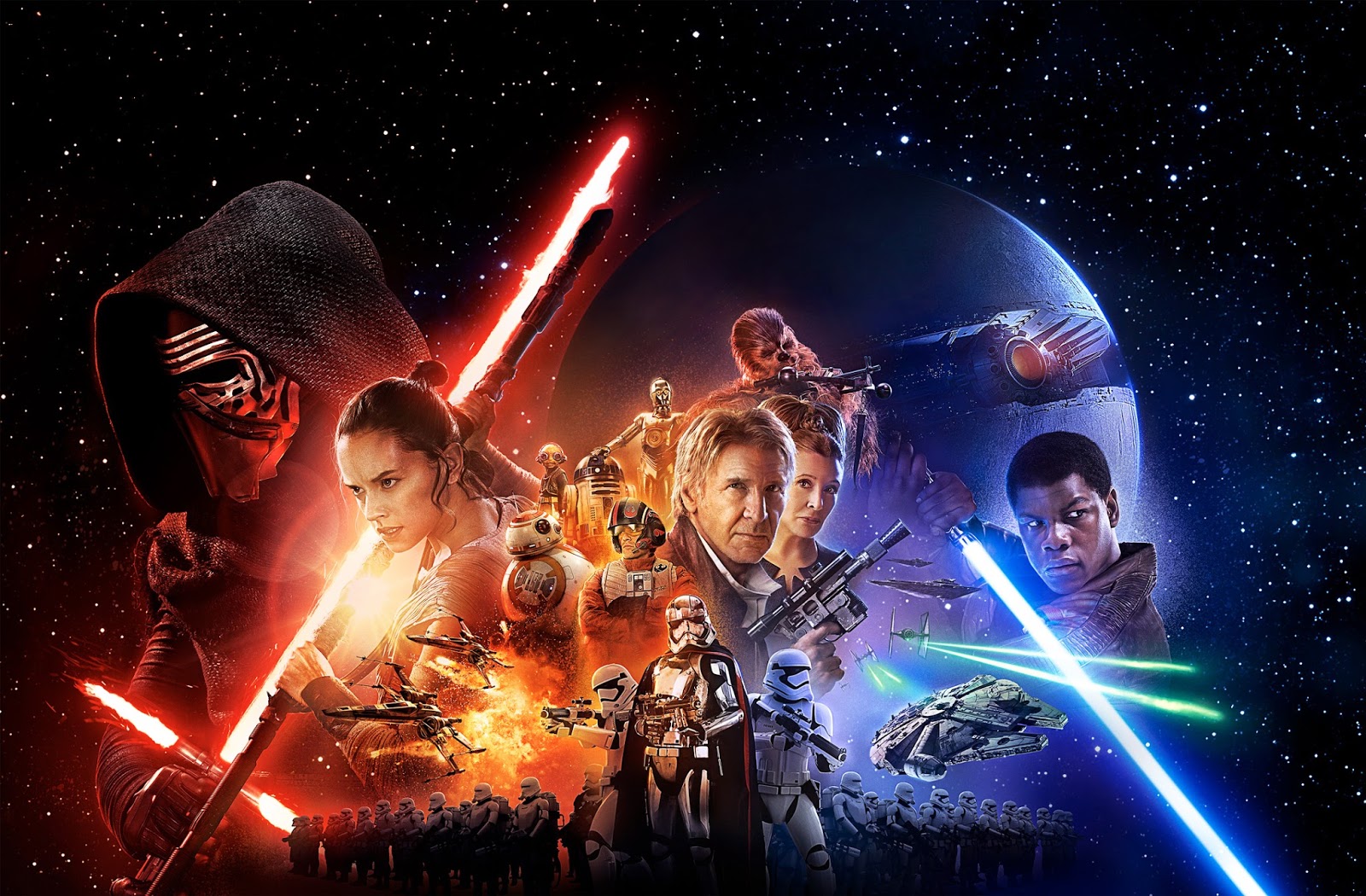
Return To A Galaxy Far, Far Away: A Star Wars Review

It has finally arrived, the highly anticipated seventh chapter of the Star Wars saga has hit theaters everywhere. For many fans, there is no better place for the holiday season and the year to end than in a galaxy far, far away. The new film, Star Wars: The Force Awakens, returns to audiences to familiar space while still pushing the beloved franchise forward. The Force is strong with director J.J. Abrams, masterfully balancing humor, action and wonder as viewers embark on this adventure. Being an avid Star Wars fanboy for over 21 years, I am proud to announce that the movie lives up to my very high expectations.

The hype for this latest installment has been steadily rising since The Walt Disney Company acquired Lucasfilm (for a staggering $4 billion) in 2012 and vowed to continue making new Star Wars films. I have personally been following every scrap of news, painstakingly analyzing each trailer frame-by-frame and speculating endlessly. Over the past few months, my excitement for The Force Awakens has bordered on obsessive, somewhat mirroring the film’s extremely zealous marketing. For essentially anyone with a pulse, it has been almost impossible to be unaware of this film’s release. It is certainly no surprise that Star Wars has vaporized box office records much like the Death Star did to the planet of Alderaan. 

The newest segment of the epic space tale picks up 30 years after the events of Return of the Jedi (1983), showing what has become of the iconic heroes and introducing some new ones. The movie feels very much at home with the tone of the original trilogy, even paralleling some story elements from A New Hope (1977). The Force Awakens does a fantastic job of creating a sense of nostalgia that flows organically with the story. Each “legacy cast member", as they were referred to during filming, is reintroduced in very fitting ways; Han, Chewie, Leia, Luke, the droids and the Millennium Falcon (a character unto itself) are all integral to the plot of the movie. Seeing these characters again is such a fulfilling feeling for fans both young and old.

The new characters also tie in excellently with the series, providing some fresh faces and storylines to the Star Wars universe. John Boyega delivers an engaging and at times humorous performance as Finn, a Stormtrooper with a change of heart. Rey, played by Daisy Ridley, is an extremely strong and self-sufficient scavenger turned unexpected hero from the desert world of Jakku. Other notable performances include Oscar Isaac as the fearless resistance pilot Poe Dameron and Lupita Nyong’o as the Yoda-esque computer generated Maz Kanata character. The film’s main antagonist Kylo Ren (Adam Driver) embodies a more immature and entitled villain than Darth Vader, a figure who Kylo idolizes. 

What truly stands out about this movie is the brilliant balance between CG and conventional effects, there are stunning visuals as well as practical sets and retro creatures designs. The film’s music is also worth pointing out, the legendary John Williams once again created a epic and moving score, using familiar themes and beautiful new compositions. Star Wars: The Force Awakens is a remarkable cinematic experience, evident by my three viewings, that induces a childlike sense of wonder. To me, Star Wars is a way of life; it is more than the merchandise, marketing or the hype, it is about the absolute feeling of joy.

Wednesday, December 16, 2015

Keep Calm And Call Captain America

One of my favorite superheroes of all time is Captain America, a man with superhuman strength as well as morals. Marvel Comics boasts a truly massive collection of larger-than-life heroic characters with unbelievable powers, incredible cunning and amazing technology, however, Captain America is easily the most idealistic. When it comes to comic book crusaders, often times the most powerful aspect of who they are is what they fight for, what they believe in. Cap truly embodies the spirit of freedom and justice, fearless as he is loyal.

Captain America No.1.
The origins of the Captain America franchise can be traced back to the Second World War, the first issue of the popular comic series being published in March of 1941. This patriotic super soldier was created by Joe Simon and Jack Kirby of Timely Comics which would eventually become Marvel. Captain America was the company's most popular comic during World War II, especially among American G.I.s overseas. This comic instilled a sense of confidence and hope, a reason to fight for the greater good. 

The popularity of this iconic series wavered after the war, even being canceled a few times before it’s more permanent revival in 1968, during the height of the tensions with the former Soviet Union. Over the years, the Captain America character has evolved becoming more complex and conflicted with the changing  times. In one of the most interesting storylines, making the big screen debut in Captain America: Civil War (click to watch trailer), forces Cap to wrestle with the idea of a superhero registration that pits him against fellow hero Tony Stark A.K.A Ironman. The patriotic hero’s internal struggles often parallel the real life political conflicts within our nation.

To me, Captain America represents not necessarily what the United States is but what it strives to be, what it could be. This righteous hero stands up for all those in the grips of tyranny and never surrenders from a fight. He also believes in the rights of freedom no matter the obstacles, he battles oppression where ever it may exist. These are personally qualities that I find to be very admirable, qualities I hope to emulate within my own life. Captain America may be a fictional character but symbolizes the very real idea of doing the right thing and having a strong sense of morality.

Whether he is battling the forces of Hydra, evil robots, hostile extraterrestrials or even other superheroes, Cap is a man of integrity bound by duty. Long before Steve Rogers was injected with the experimental serum or carried an indestructible shield, he was a strong-willed kid from the Brooklyn. He cared about others before it was expected of him and far beyond his own safety. Even when his best friend Bucky became the ruthless Winter Soldier and tried to kill him, Captain Rogers cared deeply for the well-being of his brainwashed friend.

Superheroes may be one of the most unique creations of human storytelling, drawing from elements such as ancient mythology, science-fiction, fantasy and current events. These epic tales present imaginative characters and extraordinary situations juxtaposed with relatable emotions and themes. Captain America shines as an example of modern folklore, a narrative that we can all relate to in some small way. In moments of doubt and fear, all too common in today’s world, we should stop to ask ourselves: What would Captain America do?

Monday, December 7, 2015

Not A Prop: Ableism In Celebrity Culture

One of the most puzzling aspects of American life in the 21st century is our outright obsession with all things celebrity related, the odd worship of strangers we presume to know. This bizarre cult of personality that our society supports, mostly remains a sort of benign noise constantly in the background for those uninterested but every once in a while it crosses a serious line. The latest major celebrity faux pas, not related to The Donald, is Kylie Jenner's blatantly offensive photo-shoot for Interview magazine that used a wheelchair as metaphoric prop. This act of painfully obvious ignorance, while terrible unto itself represents a larger problem in the relationship between disability and celebrity culture.

This is not ok...
When Kylie Jenner, a celebrity that requires a flowchart to trace the origins of her fame, donned her rather kinky outfit and sat in a blisteringly tacky manual wheelchair, it sent a clear message of how the industry views the disabled community. More shocking still, the supposedly “artistic” justifications behind this blunder was that it represented the limiting nature of fame. Not only does this turn an essential mobility device, that actually grants freedom, as a strange fetishized accessory but it presents disabled people in an extremely problematic light. Disability is not a metaphor to be used at will, disabled individuals are not some novelty to be imitated for shock value.

Unfortunately, Miss Jenner’s stunt that somehow no one thought was wrong before it went to print, is part of a much larger issue. Across the entertainment industry disabled people are largely excluded; disabled actors and models can get very little work, meanwhile, abled actors are cast in disabled roles and abled models are seen as the default option. The fact that Kylie’s photo-shoot even took place shows just how poorly this industry as well as the general population understands what it means to be disabled. I strongly believe there needs to be a major shift in the public narrative surrounding disability.

Blogger Erin Tatum (left) and You-Tuber Annie Segarra (right).
Fellow disabled blogger Karin Hitselberger’s now viral post, Why We Need to Talk About Kylie Jenner, perfectly sums up the importance of this discussion. As Karin puts it, "We need to talk about Kylie Jenner because this is not really about her. It is about how disability can be considered cool when used as a prop, but so often the lives of actually disabled people are seen as a terrible fate.” The disabled community’s overwhelming backlash to this celebrity blunder has sparked an important dialogue that I truly think everyone should pay attention to. The online response, in the form of blogs and recreated photos with women who are actual wheelchair users, is both empowering and enlightening.

The Kylie Jenner photo fiasco is certainly troubling, however, it does present a unique learning opportunity for the public. Anytime there is a situation in which a   particular minority group is offended by something in the popular media, the phrase “Political Correctness” tends to come up at some point but I disagree with that judgement. I believe when a specific group speaks up it is a chance to better understand those with different lived experiences, in this case disabled individuals. As a disabled person myself, I hope that perceptions will continue change and that our society will begin to see the beauty and complexity of true disability.

Tuesday, November 17, 2015

Acts of Hate

Hate and fear are the catalyst for so much of the darkness in this world, so much of the violence, the pain, the death and the suffering. The world has once again been struck by the scourge of organized terrorism, the murder of innocents with the sole purpose of creating fear. The devastating Paris attacks that have left more than 130 people dead as well as the attacks in Beirut, Baghdad Kenya and Nigeria remind us that there are still many out there who wish to do harm to all. As President Obama said in his address, “It's an attack not just on the people of France, but this is an attack on all of humanity…” 

(Tossed about but not sunk)
There is a palpable feeling of grief and despair across much of the world, especially in city of Paris as they begin to recover from the third and most deadly set of attacks this year. The United States shows it’s solidarity with France, our oldest ally, just as France has done for us in the past. My thoughts go out to all those affected by this brutal tragedy, it truly sickens me to think about such senseless acts of violence. The sense of loss, of anger, of fear seem all too familiar to the 9/11 attacks in our country 14 years ago. However, we have endured and so will the French; as the motto of Paris says, "Fluctuat nec mergitur”, tossed about but not sunk. 

Terrorism is by no means a new phenomenon but it represents the evil that humanity is capable of and the danger of indoctrination. The modern face of terrorism is made up groups like ISIS, Al-Qaeda, Al-Shabaab and Boko Haram; militant groups with a warped view of religion carrying out violence for their own perceived gain. These extremists have shown time and time again that they have no regard for human life, indiscriminately killing men, woman and children of all faiths. The vast majority of the nearly 1.6 billion Muslims on the planet firmly denounce these murderers. Terrorists represent Islam as much as the Klu Klux Klan represents Christianity.

The facts about what terrorism is and what it is not, are important to remember in the days and months ahead, particularly in regards to the refugee crisis. Many politicians and pundits in the US have already taken to using the recent attacks as political rhetoric. It saddens me to learn that the governors of around 20 states have gone so far as to say they would refuse to help the 10,000 heavily vetted refugees expected to enter our nation. In this time of international turmoil, some have chosen to turn their backs on those who understand, better than most, the suffering that ISIS has brought to so many lives. Compassion for fellow humans in need is the biggest tool that the average citizen possesses to erase hate.

No matter what you believe or where you are from, we share this world together, beating hearts and thinking brains alike. A passage from the Qur’an, the holy book of Islam, reads, “Humanity is but a single brotherhood: so make peace with your brethren.”  I may not be a religious man by my faith lies deeply withtin humanity and a better tomorrow. Peace will rise above tyranny and violence as long as there someone left to believe in it.

Monday, November 9, 2015

Michael Goes to the Dentist

It’s a Tuesday, I sit in the dentist office waiting room, Hotel California by The Eagles playing ominously in the background. “You can check-out any time you like, but you can never leave!”; the song declares as I anticipate the biannual assault on my gums. Long have I loathed this experience, the agreed-upon low-key torture that is routine dental cleaning. The hygienist arrives in the doorway smiling, we exchange pleasantries but both of us know I would rather be somewhere else, anywhere else. Going to the dentist epitomizes the concept of having to do things in life that we do not want to do.

I maneuver my wheelchair in to place, no hideous tan vinyl recliners for me. The small-talk continues as I look around the exam suite; part starship Enterprise, part interrogation room and all business in muted white and gray colors. An enormous photo of a woman’s teeth hangs from the wall, a menacing disembodied grin presiding over the room like the bespectacled eyes of Dr. T.J. Eckleburg in The Great Gatsby. What is it about going to the dentist that is so unpleasant? Is it the sights, the sounds, the smells or just the invasiveness of it all? There is something so strange about having someone you barely know put their hands and various tools into your open mouth.

The adjustable dental light shines blindingly in my face as if I am about to be questioned about nuclear launch codes. The cleaning begins, it is not particularly painful, more of a persistent annoyance. “Are you ok?” asks the hygienist, sensing my slight discomfort. “Mhmm.” I mumble over the sound of the suction. I wince again as the dental pick pokes my lower gum, my dentist office uses water-pick technology but it is still a medievalIy sharp object. My mind wanders as this irksome process proceeds, time seems to slow.

Logically, I understand the need for going and go with little protest (for the most part), however, it is one of those things I will never get used to doing. Some people actually like going to the dentist. Is it sadism? A compulsion? Clean, all must be clean. Or are those who enjoy this experience simply braver people than the rest of us, souls of stronger fortitude? I like having clean teeth as much as the next person, Americans are notoriously overzealous when it comes to our teeth, but these encounters have always felt a bit traumatic to me.

After the poking, the scraping and high-pressure jets of water, the rest of the appointment flows by like a blur. The hygienist carefully polishing each tooth and the dentist examining those said teeth, all to the soundtrack of somber elevator music. Before I know it, it’s over; everything checks out, the next appointment is made and I find myself back in the waiting-room. As I wait for my mom to return, I cannot help but feel utterly relived. That wasn’t so bad. I think to myself, what I always think to myself. I have survived, triumphed, I have gone casually to the dentist once again. 

Tuesday, November 3, 2015

A Sky Full of Stars

What do you feel when you gaze into a sky full of stars? This question, as simple as it may sound, can reveal so very much about who we are. There is something so primally human about staring at the vast expanse of space, wondering just what our place is in this universe. From the earliest humans to the most cutting-edge scientists, this fascination with the great celestial horizon has pushed our species forward. The more we understand about this breathtaking cosmos we inhabit, the more we feel drawn to knowledge, drawn the mysteries yet to be solved.

"Space is big. Really big. You just won’t believe how vastly hugely mindbogglingly big it is." Douglas Adams remarked in his humorous sci-fi series, The Hitchhikers Guide to the Galaxy. For me, just thinking about the sheer size of the known universe is a rather humbling experience; when I look at the stars I cannot help but feel small but also infinitely part of something much, much bigger. When I was around seven or eight years old my parents bought me a telescope, my father in particular took an interest in showing me the constellations and other heavenly bodies that filled the night sky. From Orion's Belt to the Milky Way, Cassiopia to Polaris the North Star, each speck of light a had story to tell. I felt part of a tradition passed down for thousands of years, from generation to generation.

Looking at the stars is so deeply ingrained in the human narrative, a tool for the imagination as well as the physical world. The stars helped us to create stories and myths, to plant crops and to navigate sea and land, they have truly allowed our society to advance. Before humanity could even comprehend the concept of anything beyond our own planet, space had captured our collective interest. As our understanding of science expanded our views of the universe passed from the realm of mysticism and legend to that of facts and logic, outer space became a tangible place. The prospect of interstellar exploration fascinated our species long before the technology to do so was even conceived. 

Science changed our perspective, imagination took us that next step forward. Jules Verne, for instance, wrote the novel From the Earth to the Moon more than one-hundred years before Neil Armstrong and Buzz Aldrin set foot on the lunar surface. When we had just barely scratched the surface of spaceflight, minds like Gene Roddenberry who created Star Trek and George Lucas creator of Star Wars, imagined a time where intergalactic travel is commonplace. Fantasy and scientific fact have both, in their own way, brought us closer to the stars. The great power of the human mind has helped us begin to boldly go where no one has gone before. 

As we imagine a brighter future, space is almost always part of that vision, part of that dream for a better tomorrow. Every astronaut, astronomer, astrophysicist and science-fiction writer started out as a child looking at the stars dreaming of something bigger. The spirit of exploration is as big a part of who we as the cosmos. Carl Sagan once famously said, “The nitrogen in our DNA, the calcium in our teeth, the iron in our blood, the carbon in our apple pies were made in the interiors of collapsing stars. We are made of starstuff.”  We are not only in the universe, we are the universe, each one of us infinitely connected to everyone and everything around us.

Monday, October 26, 2015

Live Your Truth, Love Yourself, Help Others

This past Sunday, I had the pleasure of speaking for Maureen’s Hope Youth Club, a part of Sue Bertrand's wonderful organization. I was truly honored to talk to this group of great young adults who contribute to the community in such a positive way. Below is an adapted version of my notes from my talk, while it is not necessarily what said word for word (I tend to improvise) it is the essence of what I had to say.

The theme of Sunday's event is inspired by Maya Angelou's enlightening quote, “When we know better, we do better.” Many remember Maya Angelou for her powerful literary and artistic contributions, however, another major aspect of her legacy is activism. 

Heavily involved with the movement for black civil rights both in the US and abroad, Mis. Angelou worked with leaders such as Martin Luther King Jr. and Malcolm X and Nelson Mandela. She also took part in the feminist and LGBT rights movements. In 2011, Maya Angelou was presented with the Presidential Medal of Freedom, the highest civilian honor, for her lifetime of achievement. Maya Angelou may have passed away last year but her words live on, her voice is immortal.

History is truly made by those who challenge the status quo, those who seek change within, and far beyond their own lives. Social justice movements are born from a devoted few speaking up for others and working towards a common goal. Many of my personal philosophies are inspired by the brave men and women throughout history, who have changed the world through their words and actions.

One movement, in particular, that is very important to me is the push for disabled rights that originated the 1960’s. After the Civil Rights Bill of 1964 was passed, a law that set to out to end discrimination based on race, religion or national origin, activists felt that Americans with disabilities deserved this same protection under the law. They presented the idea that access is a human right, that it is equality.

Much like with African-American civil rights, disability activists looked to change laws as well as perceptions. At the time, the majority of disabled individuals like myself were excluded from society because of widespread inaccessibility, stigma and mass institutionalization. So many people were denied a voice because of the way the system was designed. Activists spoke out not simply because it was the right thing to do but because it was the only thing to do.

Things have certainly improved as a direct result of this movement, just the very fact I’m here in front of you right now proves that. There is still a long way to go though, inaccessibility still remains; barriers both physically and societally. Some people even still struggle to connect with disabled people on a social level. There is so much we can learn from the Disability Rights Movement. The three biggest things that I have learned are self-acceptance, acceptance of others and speaking up for those in need.

Changing how I personally viewed disability, greatly helped me to accept myself. One of the most important ideas disabled activists have presented is that disability is not inherently bad, it is just part of natural diversity of life. Many of the most difficult aspects come from the lack of understanding and accommodation. It’s not to say that I don’t have bad days and frustrations but overall I am proud to call myself a disabled person. Shifting how we think about disability and disabled people helps to erase pity from our culture, something that can be very isolating. 

This change in perspective has also helped me to treat others with more respect and understanding. Early on, I was hesitant to see myself as part of a larger disabled community, I was afraid to a associate with other people who were different. I realize now that I was close-minded and missing out on a wonderful group of people. I have come to understand that there is power and companionship in shared experience. It was truly this unity between people with many different impairments, backgrounds and perspectives, that allowed change to take place and improve so many lives.

Learning to speak up for others is something crucial for creating a better future. Each of us have a unique voice in this world, a powerful chance to make a difference. We can all be ambassadors for change. Advocating for other people has become an extremely important part of my life, not just for other disabled people but for all those struggling to live there truth because of the barriers in our society. I may be a bit of an idealist but I strongly feel we all can make a difference, I believe in a brighter tomorrow made possible by our words and actions altering the world around us like ripples on a pond.

With my blog and volunteer work I strive to positively impact the world around me and share my own unique perspective. While being disabled does not define all of who I am it is a major part of my life, it has altered how I perceive things and what my priorities are. I think that every one of us has a different story to tell, a completely original truth to share. This is why I believe so passionately in embracing the brilliant diversity of life and fighting for the equality of all people.

Maya Angelou also once wrote, "There is no greater agony than bearing an untold story inside you.” So I say, live your truth, love yourself and help others to do the same.